
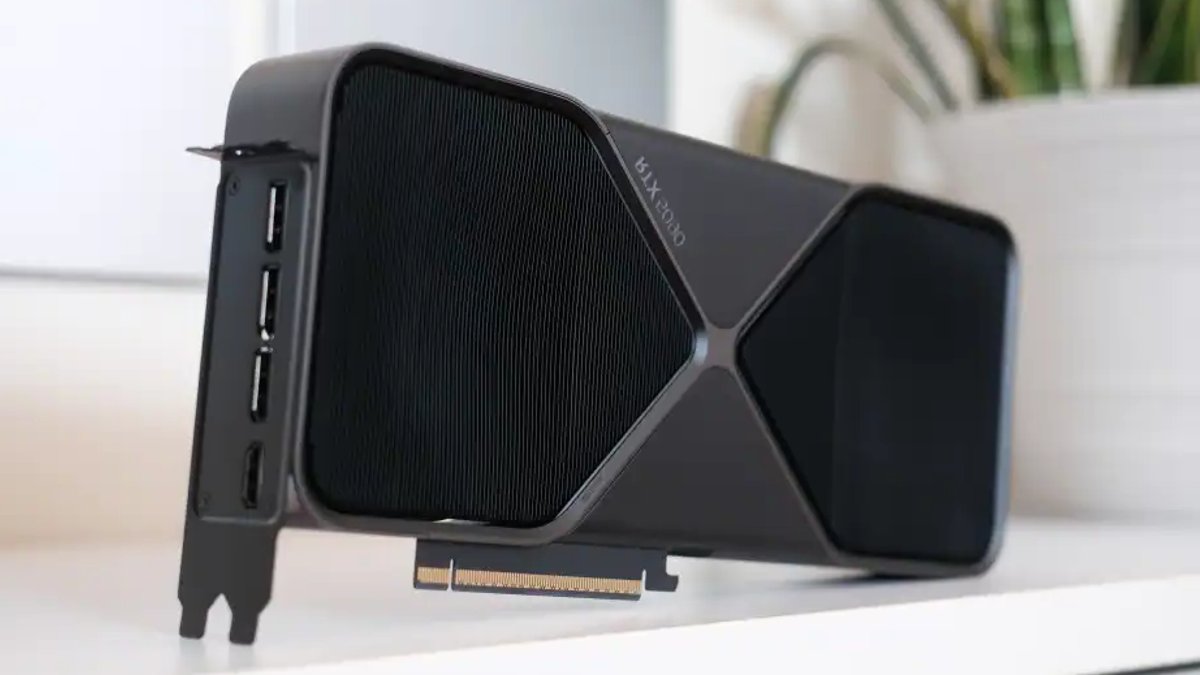
GeForce RTX 5090 graphics cards are selling for as much as $5,000 in North America, far exceeding the manufacturer’s original $1,999 price tag. The card remains the most powerful consumer GPU available, delivering massive raw performance and 32GB of GDDR7 memory. Yet the high cost creates a difficult question for consumers: does the hardware justify the expense, or is software like Nvidia’s DLSS now sufficient for most players?
The price of the flagship
The RTX 5090 launched as a massive leap in capability. It uses Nvidia’s new Blackwell architecture and is paired with 32GB of cutting-edge memory. The card was always intended for enthusiasts and professionals, but its current market price has climbed dramatically. In September, new units in North America were listed for at least $5,000, with current tracking suggesting the average is even higher.
Those figures represent a steep increase over the original launch price. The hardware itself is undeniably fast, capable of crushing demanding titles that slower cards struggle to run. However, the jump in price has outpaced many gamers’ budgets, raising the bar for entry into high-end PC gaming.
The RTX 5070 was marketed as a way to get flagship-level performance on a budget. Nvidia promoted the $549 card as delivering “RTX 4090 performance” through DLSS 4 and Multi Frame Generation. Early benchmarks showed the card fell short in traditional rendering, essentially sitting between the RTX 4070 Super and the RTX 4080 Super. This highlighted that raw rendering power is still the foundation of visual quality, even as AI techniques attempt to bridge the gap.
Recent testing by Tom’s Hardware showed a $549 GeForce RTX 5070 delivering a 240fps experience in fully path-traced Cyberpunk 2077 at 4K. This used DLSS 4.5 Ultra Performance and 6X Multi Frame Generation. The results were visually impressive, but they relied heavily on AI upscaling and frame generation rather than native resolution.
The technology works by combining several techniques. DLSS Super Resolution renders the game at a lower internal resolution before reconstructing the image at the monitor’s native resolution. Ray Reconstruction replaces traditional denoisers with an AI model. Multi Frame Generation inserts AI-generated frames between traditionally rendered ones to increase the frame rate. Nvidia’s Dynamic Multi Frame Generation adjusts the number of generated frames to maintain high refresh rates on compatible displays.
What the numbers actually say
Latency measurements tell a different story. Tom’s Hardware recorded 52.6 milliseconds of PC latency with 6X Multi Frame Generation enabled. When frame generation was disabled, the latency dropped to 35ms. Increasing the frame generation from 4X to 6X had little effect, with latency rising only slightly from 53.2ms to 52.6ms. Generated frames do not respond independently to user inputs, so the system still processes the game at a slower speed.
Players are essentially choosing between three separate metrics: raw rendering speed, input responsiveness, and visual smoothness. Nvidia’s frame-pacing hardware can sometimes make games feel smoother than native rendering, as seen in titles like Star Wars Outlaws. This creates a situation where a less powerful card can produce a visually stunning result, even if the underlying system is not as fast as it appears.
This distinction is most relevant in competitive games, where low latency is critical. Playing Counter-Strike 2 or Marvel Rivals with high frame generation often feels sluggish compared to native performance. However, for visually demanding single-player titles like Cyberpunk 2077, the trade-off is more acceptable.
The choice for gamers
For local AI workloads, professional applications, rendering, content creation, and other compute-heavy tasks, Nvidia’s RTX 5090 is an entirely different beast from the 5070. But do gamers still need anything remotely so powerful to achieve the visual experience they’re chasing? Increasingly, the answer is no.
Does the expensive hardware still matter?
DLSS is breaking the link between raw power and the visual experience. A $549 card can visually saturate a 4K 240Hz monitor in a demanding path-traced game. This raises the question of what a $5,000 RTX 5090 buys a gamer. The card offers vastly more raw rendering horsepower and a massive 32GB pool of GDDR7 memory.
Visual fidelity and the future
Single-player narratives offer a different experience. Immersion relies heavily on visual detail and atmosphere. The RTX 5090 renders these elements with exceptional clarity. Ray tracing and path tracing add realistic lighting and shadows. High frame rates enhance the sense of movement. This combination creates a truly cinematic experience. The card allows players to enjoy the highest graphical settings available.


