
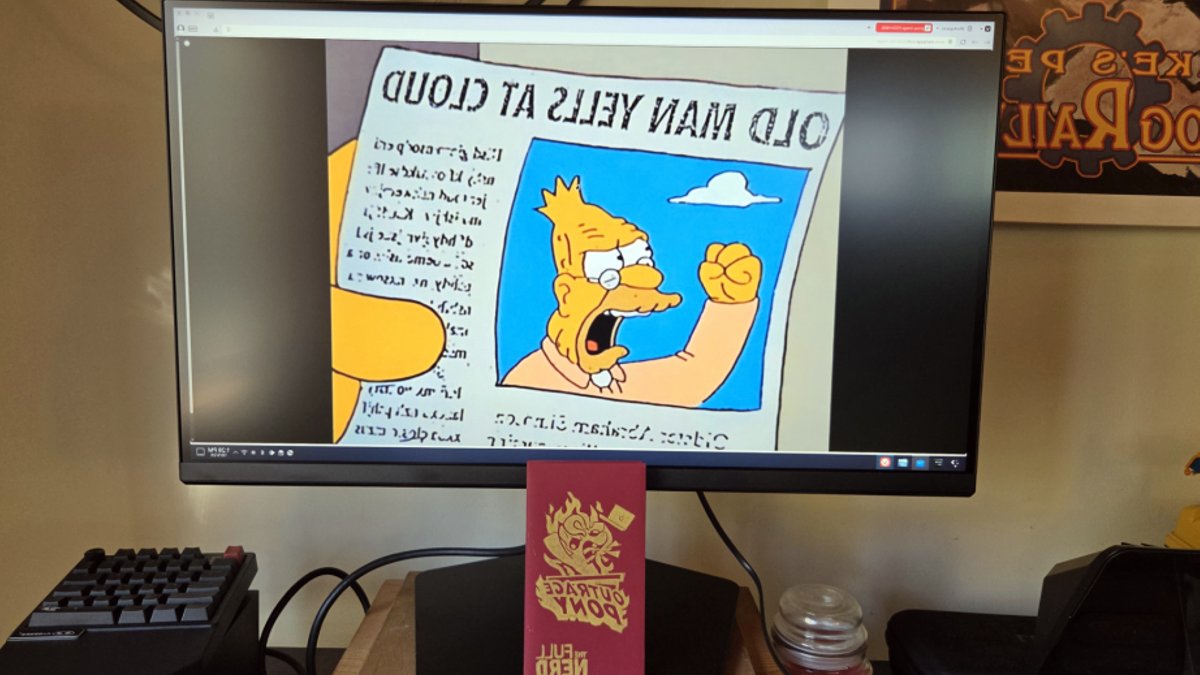
A 27-inch monitor with 5K resolution and 180Hz refresh rates sounds like a dream for many PC gamers, but for one writer, the hardware highlights a stark reality about aging eyes.
The Specs vs. My Vision
The Samsung Odyssey G80HF sits at 5120×2880, a density that requires a close look to appreciate. The writer notes that at just 27 inches, the screen is too small to see details clearly from a normal viewing distance. While the panel offers 180Hz at its native resolution, Samsung included a dual-mode option: dropping to 2560×1440 boosts the speed to 360Hz. Yet, the writer claims they cannot distinguish between 240Hz and 360Hz, noting their eyes simply do not show a perceptible difference.
This experience costs money. The monitor lists for $950, though it is frequently found closer to $700. The writer argues the price does not justify the return on investment for someone with their vision. They instead suggest a $300 QHD monitor at 240Hz would suffice.
Reflexes in the Digital Age
The limitations extend beyond screens to the mechanics of play. The writer discusses their struggles with Fortnite, specifically the Battle Royale mode, which requires rapid building alongside combat. They describe the coordination as “break[ing] my brain,” noting they cannot switch between building and shooting seamlessly. After a year of trying tools like lightsabers and web-shooters to counter building, the writer abandoned the mode entirely. They refer to this no-build version as “Old Man mode.”
Read Also: Counterfeit SSDs Deceive Buyers with Fake Storage Capacity
This difficulty with rapid, dual-tasking mechanics mirrors the writer’s experience with modern gaming peripherals. Adjustable actuation keyboards allow for “snap tap” and macro-heavy inputs, but the writer lacks the reaction time to use them effectively. They also dismiss the value of ultra-high polling rates, such as 8000Hz on mice, stating they have never been able to tell the difference between four thousand and eight thousand refreshes per second.
These technical barriers are not unique to the writer but reflect a broader trend in gaming demographics. The average age of a professional e-sports player is between 20 and 25, with 30 considered retirement age. The writer points out that for those past 35, the window for professional competition has closed. While this does not stop enthusiasts from enjoying games, it forces a reevaluation of how hardware investment translates to actual gameplay improvement for an older demographic.
Gaming Gerontology
The writer notes that the reaction to this observation may be dismissive. Some readers might feel 39 is too young to voice these concerns. However, the writer insists that everyone eventually faces these physical changes in their hobbies. The source material highlights the age of professional competitors.
The history of gaming is longer than the current generation. Parents played video games while they were dating. The writer notes that people who were five years old when arcades became popular in 1980 are now approaching retirement. By the time the writer’s generation reaches retirement age, they will have played games their entire lives. The future of gaming includes a larger number of older players.
Read Also: Gigabyte’s new gaming laptop balances power and practicality
The writer imagines a scenario where older gamers gather in retirement homes. They might struggle with complex inputs like a Falcon Punch. This image is presented as optimistic. Despite these challenges, the writer mentions their grandmother. She is almost 90 years old and recently enjoyed the game Balatro. This anecdote suggests that games can remain relevant and engaging across a wide range of ages.
Game Pick of the Week: Wildermyth
The writer expresses a desire for a turn-based role-playing game. This interest stems from the breakup of a Dungeons & Dragons group. The writer has also abandoned multiple runs of Baldur’s Gate III. For those seeking a more manageable option, the source recommends Wildermyth. The game is a turn-based fantasy RPG with procedural generation. The mechanics randomize almost every aspect of the experience. This ensures that players will not encounter the same campaign twice.
The combat system in Wildermyth is simplified. It offers a tactical experience in a bite-sized format rather than a full meal. The unique feature of the game is the character growth system. Party members interact with one another in unpredictable ways. The writer notes that playing through multiple stories can reveal intergenerational threads. Old heroes from previous campaigns may return in surprising ways. The game has a limit to its variety, so the stories are not infinite.
Gaming Options for an Aging Audience
Older adults are beginning to picture themselves gaming in retirement settings, even imagining a Falcon Punch duel in a senior-care lounge. Some seniors already demonstrate unexpected enthusiasm; a nonagenarian grandmother recently adopted the card-game Balatro, showing that new titles can still attract very mature players. This suggests that the idea of retirees gathering around televisions for casual competition is plausible, though it remains an optimistic scenario.


